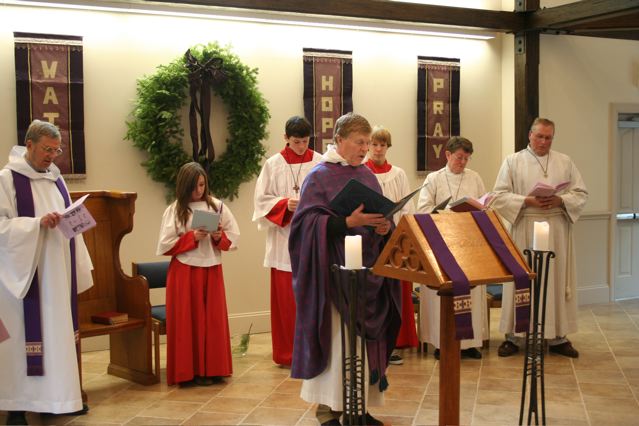
During May, we at Holy Cross will be engaged in a review of our liturgy, the way we worship. (The word liturgy comes from Greek meaning “work of the people.”) As an introduction to this project, I offer a very brief summary of the history and basics of worship in our Episcopal/Anglican tradition. Continue reading ‘History and Basics of Anglican Worship’
Archive for the 'Worship' Category
The Episcopal Church is a liturgical church, which means that at the heart of our life is our Sunday worship. Each Sunday we celebrate the Holy Eucharist, the original and most ancient form of Christian worship, instituted by Jesus himself. In the Eucharist we don’t just “say,” we “do.” This service is also called Communion or Mass. Our worship is drawn from the Episcopal Book of Common Prayer, often called the most beautiful liturgy in the English language. You’ll find that Episcopalians value beauty in worship, and the kind of structure which allows all worshipers to feel at ease and participate. Weekly bulletins help you find your way. Continue reading ‘About Worship at Holy Cross’
Of all the anxieties that visitors and newcomers to a church experience, “Can I receive Communion?” is probably right there at the top. There’s a fear that if one joins the congregation in coming forward at Communion time and one shouldn’t . . . an alarm will go off, God will hurl down a lightening bolt, or the priest will publicly humiliate you.
Well, none of those things will happen at Holy Cross! If a visitor comes to receive the Sacrament, she or he will receive it. At the same time, we do follow a simple rule, which is the requirement for receiving Communion in the whole Episcopal Church. That is, you should be baptized. Continue reading ‘Joining in Communion at Holy Cross’

The processional cross at Holy Cross was made by Weare blacksmiths Cook's Forge. It is a Celtic cross, and echoes the pattern of the window above our Altar.
Someone coming to Holy Cross from another denomination remarked, “The thing I like about it here is people are free to do different things at church: sit, kneel, stand, cross themselves, bow or not.” We do have that kind of flexibility. But sometimes people want a bit of guidance in feeling their way to what works for them in worship. So here’s an attempt to provide that. Continue reading ‘“Body Language” in Worship’
For the last year, Holy Cross has been experimenting with periodic “Come With Joy” Sundays. These are inspired by a ministry of Caroline Fairless and Jim Sims called Children at Worship ~ Congregations in Bloom. Caroline, an Episcopal priest, and her husband Jim, a musician and composer, have a mission to make Episcopal worship more attractive to children, teens and young adults. They bring a rich array of music, drama, visual arts and other exciting ideas to Sunday morning Eucharists. Continue reading ‘Come With Joy Sundays’
Acolyte – those who assist at the service, at Holy Cross usually young people, vested in red cassocks and white cottas.
Alb – the white under vestment worn by ministers at the Eucharist, symbolizing the purity of baptism.
Altar – the Holy Table at which the Eucharist is celebrated.
Altar Guild – a group of volunteers who prepare the vessels and vestments for services.
Bishop – a person ordained to have oversight for a Diocese; in the Episcopal Church, ordinations are for life, so Holy Cross member Arthur Walmsley, though retired, remains a Bishop. (He was Bishop of Connecticut.)
Chasuble – the vestment worn by the Presider at the Eucharist.
Chalice – the Cup containing eucharistic wine (based on ancient tradition and Scripture, the Episcopal Church requires the use of wine, not grape juice, for Communion).
Diocese – a subdivision of the national Episcopal Church, in our case comprising the state of New Hampshire.
Eucharist – (Greek for thanksgiving), the ritual liturgy celebrated on Sundays from the very beginning of the Church.
Eucharistic Ministers (LEMs) – lay persons licensed by the Bishop to assist in administering Communion.
Font – the baptismal Font that stands by the entrance to the worship space, normally filled with blessed water as a reminder of baptism.
Hymnal – the red song book contained in the book rack beside each chair; we also use music from a green paperback book, Wonder, Love and Praise as well as from other sources.
Intercessor – the person who leads the Prayers of the People.
Lectern (or Ambo) – the Bible stand from which lessons are read.
Lector – the person who reads a lesson (gospel readings must be read by an ordained person.
Presider – the priest or bishop who presides at the Eucharist.
Stole – the scarf worn by an ordained person, symbolizing the authority of the Church.
Vestry – the elected body responsible for the temporal affairs of the congregation.
Vicar – the priest in charge of a mission or aided congregation.
Warden – the two senior elected lay officers of the congregation.
Worship Booklet – the seasonal booklet contained in the book rack beside each chair which contains the texts for the Eucharist; these are drawn from the Book of Common Prayer and authorized supplemental sources.