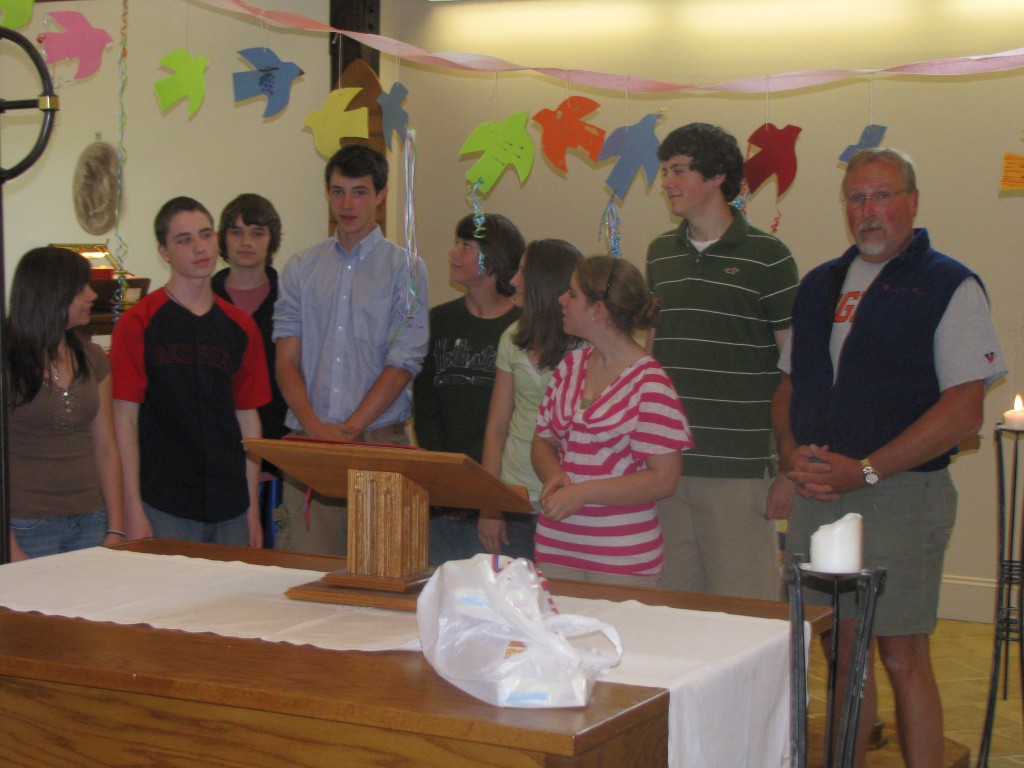
On All Saints’ Day, November 1, the Holy Cross Youth Group did a presentation on members’ favorite saints for the congregation at the Eucharist. It was a diverse selection of men and women from the Episcopal calendar of saints (and beyond). Each presentation was accompanied by a Power Point picture of the saint. Following are some of the offerings.
Paul Jones (presented by Abbie Stehno). Paul Jones was born in Pennsylvania in the 1800’s. He went to Yale and the Episcopal Divinity School in Cambridge Mass. He served at a church in Logan, Utah and in 1914 was made the bishop of the Missionary District of Utah. Around this time WWI broke out. Since Paul Jones was a pacifist he spoke against it. This conflicted with the views of the church’s and was forced to resign because he was “promulgating unpatriotic doctrines.” Because he was still a bishop but without a church, he became part of the interdenominational Fellowship of Reconciliation in Manhattan. He died on September 4, 1941.
Dietrich Bonhoeffer (presented by Sonia Schuler). Dietrich Bonhoeffer was a German Lutheran pastor and theologian. He resisted the rise of Nazism in Germany and was found out by the Nazis after conspiring to overthrow Hitler. Bonhoeffer represented the cost of being Christian. He traveled to the U.S. and could have been free from persecution. Against all advice he chose to go back to almost certain death and continued to preach the Gospel. When he returned to Germany he was imprisoned and wrote many hymns and letters of inspiration. Bonhoeffer was later executed on April 8, 1945 by the Nazis. Dietrich Bonhoeffer sacrificed his life to expose the Nazis’ abuse of power.
Elizabeth Cady Stanton (presented by Monica Houghton), born on November 12, 1815, was an American social activist abolitionist, and leading figure of the early woman’s movement. Her Declaration of Sentiments, presented at the first women’s rights convention held in 1848 in Seneca Falls, New York, is often credited with initiating the first organized woman’s rights and woman’s suffrage movements in the United States. Before Stanton narrowed her political focus almost exclusively to women’s rights, she was an active abolitionist together with her husband, Henry Brewster Stanton and cousin, Gerrit Smith. Unlike many of those involved in the women’s rights movement, Stanton addressed a number of issues pertaining to women beyond voting rights. Her concerns included women’s parental and custody rights, property rights, employment and income rights, divorce laws, the economic health of the family, and birth control. She was also an outspoken supporter of the 19th-century temperance movement. Elizabeth Cady Stanton died on October 26, 1902. The Episcopal Church added to its Calendar four American women who were pioneers in the struggle for black emancipation and for women’s votes. The date chosen for commemorating them is the anniversary of the Women’s Rights Convention held in Seneca Falls, New York, 19-20 July 1848.
St. Lawrence of Brindisi (presented by Connor Houghton) was born on July 22, 1559. He was originally named Julius Caesar. When he was 16 years old, he was entered into the Capuchin Franciscan Order in Venice, Italy. It was then that he received the name Lawrence. He was ordained a priest at age 23 after already having completed studies of both philosophy and theology at University of Padua. He had an amazing gift of languages throughout his life. He could speak and read fluently in Italian, Latin, Hebrew, Greek, German, Bohemian, Spanish, and French. Because of this gift, he was able to study the Bible in its original language. He preached for the Jews in Italy because of a request from Pope Clement VIII. The rabbis there thought he was a Jew who had become a Christian because of his complete knowledge of the Hebrew language. A fifteen volume edition of his writings, eleven of them being sermons, was completed in 1956 by the Capuchins. He used many scripture references in his writings and in his sermons. Though he was a very talented scholar, and a genius of languages and other matters, he was still very sensitive for the needs of people. At age 31, he was elected to be the major superior of the Capuchin Franciscan province of Turkey. He was very good at this job. He was promoted to be the minister general of the Capuchins in 1602. He was then responsible for much of the growth and expansion of the Order. He was a peacemaker also. He was appointed to be the papal emissary, which let him travel to many countries including his native Naples. He traveled to Lisbon on this job. He got seriously ill there, and died in 1619 on his sixtieth birthday. Overall, Saint Lawrence of Brindisi had a great holy life. Not only was he a scholar, but he was also a very holy man and a priest. His devotion to God and Scripture showed a life that is a model for Catholics and other Christians today. He was sensitive to peoples needs, and had great self discipline and appreciation for others needs. His feast day is July 21st.